In Conversation: How Mackenzie Construction and UAV 365 Are Transforming Treated Water Asset Management
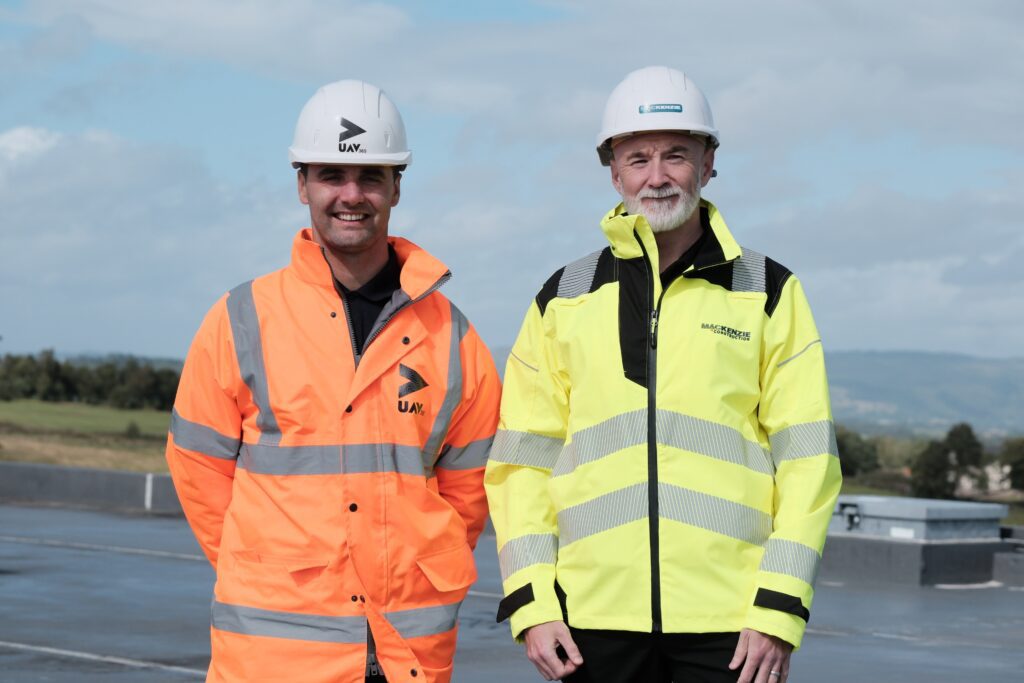
Following the launch of our new underwater 3D scanning service for live treated water assets, we sat down with Mark Brown, Structural Refurbishment General Manager at Mackenzie Construction and Kieran Smith, Operations Director at UAV 365 to explore the AquaVis 3D partnership, the technology and what it means for the future of treated water asset care.
Q: Can you briefly introduce yourselves and your roles in this partnership? What inspired Mackenzie Construction and UAV 365 to collaborate on AquaVis 3D?
Mark: I lead our Structural Refurbishment division at Mackenzie Construction where a big focus is working with our water sector clients to improve water quality by strengthening asset resilience, safety and sustainability. We’ve long felt the limitations of traditional inspection methods when it comes to treated water assets and knew there had to be a better way to give operators the full picture while keeping assets online.
Kieran: I’m Kieran Smith, Operations Director at UAV 365 and we specialise in complex inspections across demanding environments. AquaVis 3D came from marrying our live underwater scanning capability with Mackenzie Construction’s water sector expertise. The shared ambition was clear: meet hygiene standards, avoid downtime and deliver data-rich 3D models that asset owners can trust.
Q: What are the biggest challenges with traditional treated water inspections?
Mark: Treated water assets are extremely difficult to inspect safely and efficiently. Access is limited with inspections often needing full drain-downs and we end up relying on manual confined-space entry or basic ROV surveys that only show part of the picture. For asset owners, that means operational disruption, higher cost, and long periods where a tank or reservoir is offline. The biggest challenge is the lack of reliable, repeatable data. Without accurate condition information, it’s harder to plan interventions, justify capital spend or understand deterioration trends.
Q: How does AquaVis 3D address these challenges and what makes it unique?
Mark: AquaVis 3D lets us inspect treated water assets while fully operational. In one pass, the ROV captures high‑resolution video and 3D scan data, delivering both a visual inspection and a measurable digital model. For the first time, we can see structure, substrate, defects and exact geometry, all without drain‑downs and without confined‑space entry. It removes risk, reduces cost and provides the depth of information asset owners have been missing.
Kieran: The uniqueness comes from combining drinking‑water‑compliant ROV operations with true 3D mapping/digital‑twin capability in a live environment. ROVs exist, and so do 3D scanning tools but bringing them together at this standard in drinking water and producing usable 3D deliverables, is the breakthrough.
Q: How does the underwater drone and 3D scanning work in live environments?
Kieran: We use a stereo‑based camera system in combination with an underwater ROV. Using the principles of photogrammetry, we capture thousands of paired images and stitch them into accurate 3D deliverables. Because we operate in dark tanks with sediment typical of live environments, we also use powerful lighting to ensure crisp image capture.
Q: How do you ensure data accuracy and hygiene compliance?
Kieran: The unit is dedicated to clean water environments and kept sterile for that purpose. We are also exploring specialist sterilisation before jobs, with certificates as an extra layer of assurance. On accuracy, our controls are built around methodical scanning and proven expertise, with UAV 365 having a strong track record delivering 3D scanning and digital twins across multiple sectors and various complex environments.
Q: How will Mackenzie Construction integrate AquaVis 3D into client workflows?
Mark: Our goal is to embed AquaVis 3D into routine condition surveys, capital maintenance planning, pre‑construction design and scoping, construction verification and handover and long‑term digital asset records. The data can feed into existing client systems including GIS, asset management platforms or BIM so there is no need to change how teams work. We’re simply giving them better information.
Q: How do digital twins change the game for water infrastructure management?
Kieran: Digital twins act as a dynamic, living record of your assets. They allow designers, engineers and operators to collaborate on a single model and annotate, measure and compare conditions over time. Instead of relying on isolated snapshots, decisions are informed by historic trends and real-world performance data. This means you can identify patterns in how specific tank types degrade, anticipate issues before they escalate and move from reactive fixes to truly proactive asset management.
Q: What message would you share with water sector stakeholders about embracing technology like AquaVis 3D?
Mark: Start using digital data now. Every year you delay is another year of decisions made with incomplete information. AquaVis 3D gives you control, clarity and confidence in your assets — and that’s invaluable.
Kieran: The water sector is at a turning point, moving away from outdated inspection methods toward advanced, data-rich 3D deliverables. AquaVis 3D positions operators ahead of the curve, enabling smarter decisions and setting a new standard for asset care.
You can learn more about AquaVis 3D here.